A common question I am asked at nearly every literary gathering is this: How do you juggle life as an IT engineer and a novelist? I never seem to provide an answer that satisfies either camp. Writers and engineers alike quietly dismiss whatever I say. Writing novels and engineering software are such disparate domains that the possibility of mutual understanding, let alone peaceful coexistence, seems non-existent. Anyone who tries, as I do, soon pays for it with their health.
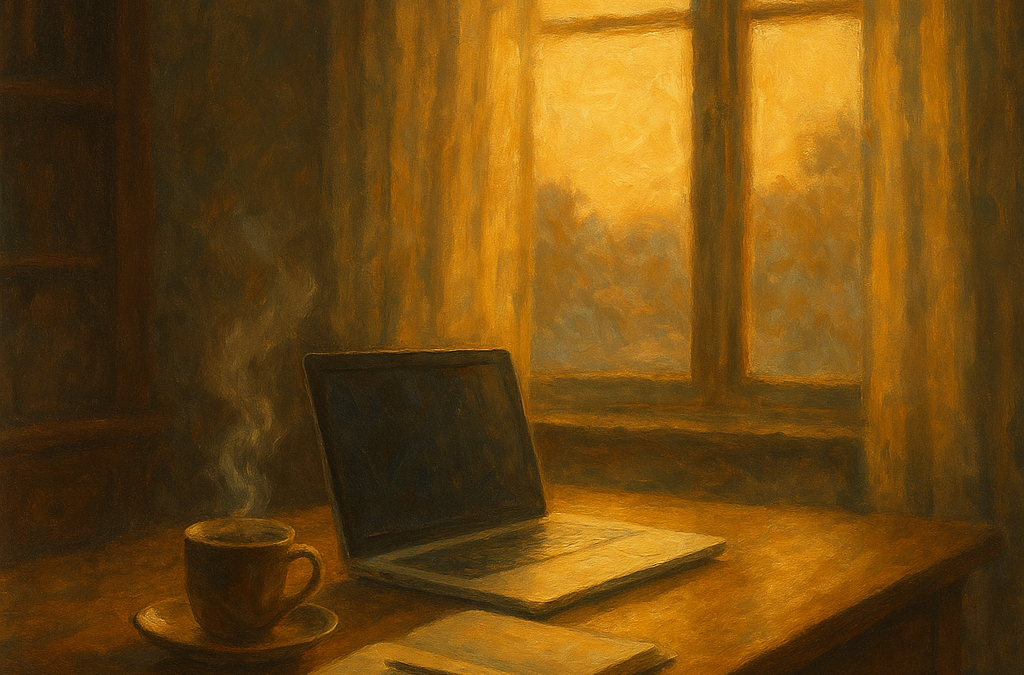
Take my own routine. I write or read at five in the morning, accompanied solely by a strong filter coffee. By the time dawn breaks through the window of my east-facing study, I must step away. My son needs to be prepared for school, and I, too, must get ready. This routine, cultivated over many years, has become so deeply ingrained that even if offered time during other parts of the day, writing proves impossible for me.
Then came a day when my company expanded its business to Australia. Consequently, Customer calls began at 4.30 a.m. my time and ruthlessly swallowed that precious hour whole. While I was still rubbing sleep from my eyes, Australian managers -already breakfasted and brimming with energy- settled in for meetings they had no wish to end. That is the fate of service companies: even the privilege of ending the call belongs to the client.
As a practice director, I knew it wasn’t something I could simply complain about, yet I still voiced my concern, gently, while my boss and I were on a Friday break, leisurely sipping beer. He saw nothing grave in the issue. “Write in the evening, write at night; take an hour off at noon if you must,” he generously suggested. He did not grasp that writing cannot be timetabled and I could not make him see it. Writing a story is not merely about availing time; it is not akin to allocating slots for tasks like fixing software bugs. Could one possibly pen a love song moments after a heated argument?
Throughout the Australian project I wrote nothing. This brought sorrow to no one but the writer residing within me – not even to the engineer who shares the same skin. The project proved profitable for the company, and I received a handsome bonus. Who, then, lost because I did not write? Who grieved?
None of today’s professions truly tolerate, let alone accommodate, the creation of literature as a parallel pursuit. Our jobs reshape our very mindset. An IT professional in a bustling metropolis cannot realistically blend coding with writing: every minute, every cell, is claimed by the job. After a fourteen‑hour shift, simply reaching home to sleep feels like an achievement. The child may already be asleep; a quick kiss on that drowsy cheek is all the life‑affirmation he can muster. When, then, is he to write? Forget writing, he can scarcely read. If he opens a book on the metro, it is usually about harnessing AI at work—an endless text whose content is already outdated by the time the book is printed.
Offer a Bengaluru engineer the option of becoming a writer and his first question will be, “What’s the per‑hour earning rate?” Once he learns it hovers near zero, he will not spend another second on the conversation. Given this reality, the act of writing a novel – nurturing a theme in one’s mind for years, spending countless days and nights with characters who operate outside the realm of real world – must seem like an endeavor only a fool, utterly lacking the street‑smartness, would undertake. Rilke urged the young poet, “Write only if you must.” Modern life has stripped the “must” from art.
In conversation, many of my colleagues subtly and tactfully ask how much one can earn by publishing a book—especially in Kannada, as I do. When I answer, “Compared with an IT salary, it is virtually nothing,” a flicker of astonishment crosses their eyes. They bite back the next, potentially insulting question that hangs in the air. Though unspoken, I still hear it.
Pampa, the tenth‑century poet, highly regarded as the first poet of Kannada, asked, “kaviteyoL Asegeyva phalamAvudo?”—What fruit, after all, does the longing for poetry yield?
A thousand years later, too, this ancient question remains tragically unanswered, helplessly circling the globe with the speed of the internet, seemingly cursed to echo through time.
Leelavathi S N
Very nice, love to read your stories, very well knit
Chandrasekaran Ramadasan
You have captured the dilemmas of modern life beautifully in this small writing. People suffer more from their incompatibility than their suitability to the world. I felt like reading a page out of your ‘What’s your Price’ book. – CR