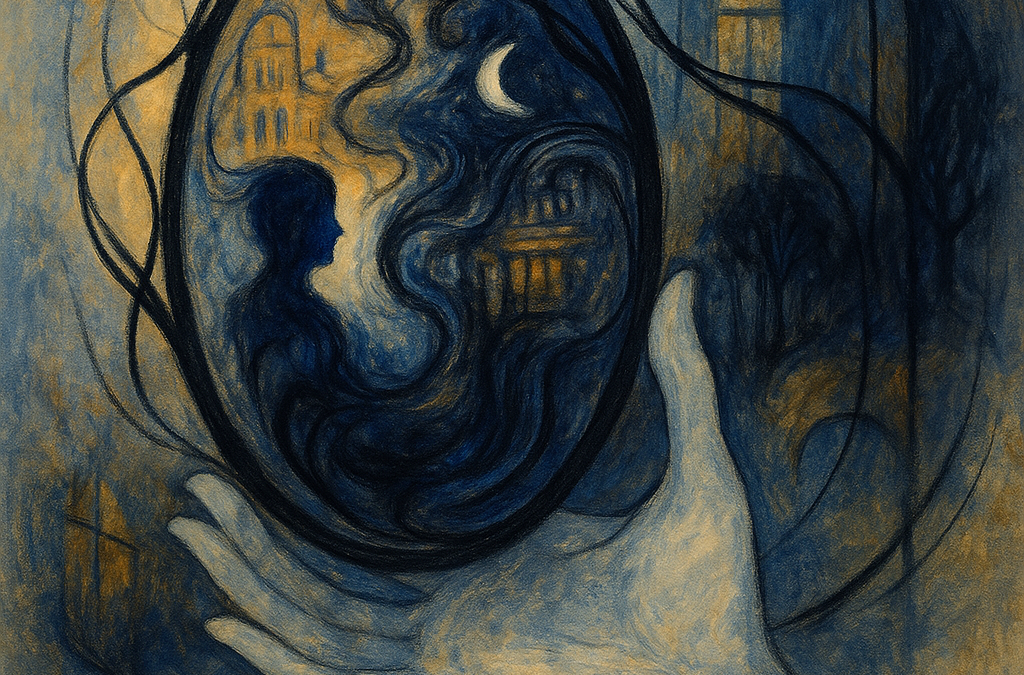
In Ovid’s 2000-year-old Latin epic Metamorphoses, Narcissus is so beautiful that, while still a child, a fortuneteller warns his mother, “Nurture him so he never looks at a mirror. If he does, he’ll fall victim to his own infatuation.” The fortuneteller was old and blind!
True to the prophecy, Narcissus grows up unaware of his own beauty, never having seen his reflection. However, one day, he sees his image in the clear water of a pond. Spellbound, he cannot look away; he forgets food, drink, and the world outside, and in that self-enchantment, he loses his life.
When creating a character, a writer must remember that a character’s outward appearance and inner essence can both echo Narcissus. If the storyteller gazes too deeply inward, the character sheds the very skin with which it meets the world, shrinking from sunlight and seeking the safety of darkness. Worse, bewitched by its own form, it judges the rest of the world as coarse, unbearable, and eager to inflict cruelty. Like Dostoevsky’s Underground Man, such a person is driven by wounded pride and vanity to rebel against every rational order, even those within himself. In the end, only the reflection that consumes him stays; like Narcissus, he finds the image lovelier than life itself.
At the other extreme, a Narcissus who never once sees his reflection becomes a different kind of aberration. Infatuation aside, the truth is that nothing in this world is more beautiful than our own reflection. Nothing is clearer than that. A character gains its depth from its reflection, not from the vast ocean of the outside world. The character who doesn’t look at the mirror is like a light-boned, pitch-dark creature blindly crossing a forest on a moonless night; it stirs neither the inner world nor the outer, and before it learns anything of life, it slips into oblivion. Sufi mystic Rumi’s words stand in stark contrast to those of the blind prophet: ‘Give the beautiful ones mirrors, and let them fall in love with themselves; That way they polish their souls.’
Therefore, if we must create, one should fashion a character who looks both within and at the world beyond the window. Let it live not at the poles but in the fertile valley between them, mingling with people yet standing apart, gazing into the mirror yet refusing to become its slave. Let it walk fondly through the bazaar and, at dusk, stand by a shuttered shop, smoking a cigarette in quiet solitude. The revered Kannada poet Kuvempu’s line from the poem ‘Anandamaya ee jaga hridaya’ goes like this: Shiva kaanade kavi kurudano Shiva kaavyada kanno – which can be loosely rendered in English as, “Without the vision of Shiva – the very eye of poetry – a poet is blind.” The inner cannot exist without the outer, and vice versa. Bhagwan Shiva has three eyes: two that look outward and one that looks inward.
Yet characters are like children born to us. You might wish them to be a certain way, but they become what they are destined to be. At the end, it’s like aged parents sitting on their balcony at sunset, thinking of their son who eloped from home, pondering, “What did we do wrong in raising him?” Such is the storyteller’s predicament.
Consider the helplessness of Narcissus’s mother. She could cover the mirrors in the house, yet outside lie a thousand surfaces ready to give back an image. Let a light shower fall and a red puddle form by the outdoor steps, enough for the boy to lose himself in his reflection. When the boy loses his life, her heart might have wailed, “Oh, if only he had been born blind!”
Wish as one might, nothing is in her hands, just as nothing is finally in the storyteller’s.